
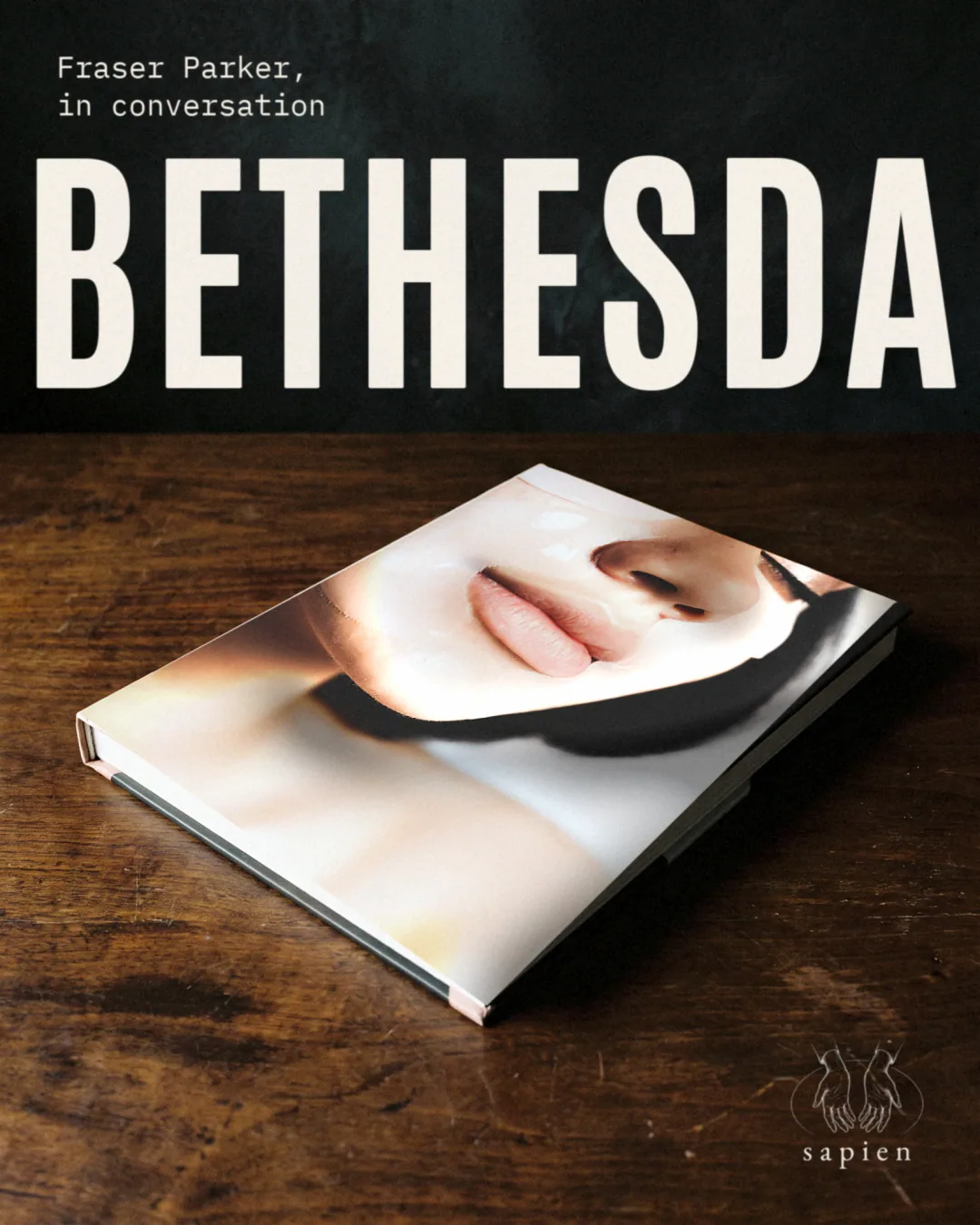
Where does the name Bethesda come from?
Bethesda was one of the titles I considered for my billet-less word guess, which I eventually called Progeny. I liked the name partly because of the gaming connection. Bethesda sits in the same wider family as id Software, the original creators of DOOM, and I have always admired John Carmack’s genius for optimisation and getting incredible performance out of limited hardware. The name also has the Jerusalem connection through the Pool of Bethesda, which gives it a nice hint of mystery, healing and the supernatural.
What was the moment the central principle clicked for you, and how long did it take to go from that to a full system?
I remember thinking back over older ideas and the compromises I had made, especially around how a spectator could cue the performer without any obvious movement, my eye close cue or the need to hold hands. As often happens when you are pondering concepts and letting your mind wander, ideas start connecting, and the core notion suddenly dropped in, informing the other ideas I was already considering and letting me play with how they might work together.
As soon as I had the basic cueing idea, I got my stepson to stand in front of me and follow a simple instruction so I could see whether I could discern it reliably. I could, and from there the rest started falling into place quickly, becoming a cleaner, more streamlined and more efficient version of approaches I had explored before.
Progeny gave us the billet-less peek with keywords, then Mantis took the keywords away and got it down to one natural line of scripting. What does Bethesda do that Mantis and Progeny couldn’t?
Although the end result is still the ability to create the illusion of mind reading without using props, this system is designed to achieve it in a very different way and to open up different possibilities. It can determine any thought that can be broken down into binary information, while also allowing for a clean form of pseudo equivoque where choices can be subtly guided or adjusted, so thoughts can be forced, influenced or predicted as well as simply read.
Are there still situations where you would reach for Progeny or Mantis instead, or do they all work together?
Yes, I would still use those methods specifically for names and certain types of words, because they work incredibly well for that kind of problem. Bethesda is better suited to effects where the information can be narrowed down through a few impressions or a series of possible variables, and it also allows for an incredibly clean approach to anagrams where the spectator never has to verbalise anything.
The different systems let you arrive at information in different ways, so I see them as complementary and would use each one depending on the information involved, the presentation and how I want the performance to feel.
With Mantis the letter guess is right two thirds of the time and you still land the word. What does the hit rate look like with Bethesda in real performance, and when something goes off what do you do?
Because the system is mechanical, the hit rate really comes down to calibration. Done entirely prop-less, I find it gives me well over a 90 percent hit rate. Once the few necessary words are spoken and the process is set, it runs silently underneath the presentation and, if you are locked in correctly, should continue working throughout.
If I do miss, I simply move on. I never perform it in isolation, but as part of a set of other effects, so the occasional miss can actually make the overall impression feel more believable. For me, that is a worthwhile trade-off for being able to create something that feels like a miracle with no props at all.
How practical is it in the real world? Noisy bar, walkaround, one on one, at a dinner table, on stage, even Zoom?
It was designed to be practical from the outset and deliberately engineered to work with just a few words. A noisy bar is only really a problem if the spectator cannot hear your impressions, and the method is well suited to walkaround, dinner tables and even stage work, although I personally prefer it close up because there is always a small chance of failure. It can also be performed over Zoom, but I think it is strongest when experienced live in front of other people or a larger audience.
How much memory work is there, and how long before someone who picks up the book can perform it confidently?
There is zero memory work for the system itself beyond learning the scripting and the basic structures that make it work. For certain applications, such as the star sign revelation, there will be some of the typical memory work that goes along with that type of effect, knowing which set of outs you are dealing with based on their responses.
Some people will be able to start performing it almost immediately, although mental rehearsal and a little practice will obviously make everything smoother. It is deliberately easy to perform, so once you understand the structure you should be able to use it with confidence.
You say the spectator is completely fooled too and never becomes an instant stooge. What does it feel like from their side, and what do they remember when they tell someone about it later?
They are fooled in the sense that they still do not know how you know the information you read from them, and they have no reason to feel they were somehow stooged. They will remember following a process that seemed to help you connect, but they still would not be able to tell anyone how you were able to achieve these results.
To the rest of the audience it can appear even stronger, while the basic effect of mind reading is still maintained. It is the structure, and the way everything weaves through the perception of both the spectator and the audience, that allows you to achieve these results so effortlessly.
What’s the strongest reaction you’ve had from performing Bethesda so far?
I remember one university student completely freaking out when I guessed their star sign, although I think the reading statements around it were just as strong and helped bolster the reveal, with both elements reinforcing each other.
It goes way beyond anagrams to star signs, playing cards, drawings and colours. Which application surprised you the most?
I would not say any of the applications surprised me. These principles and concepts simply gave me more compact and streamlined ways to develop specific approaches I had already explored. My work tends to follow a constant line of development and evolution, using familiar premises as vehicles for new ideas and refining those existing approaches to achieve similar results in cleaner and more efficient ways.
You also mention a really clean equivoque where you can influence or predict the choice ahead of time. How does that change the way you build a routine?
It doesn’t really change the underlying method. The setup and foundation principles are the same, it just means slightly adjusting the outward presentation. Whether you’re verbalising your impressions, stating the obvious options open to the spectator or giving them the chance to change their mind, it still feels completely in line with how the process might look if it were real.
Why was it important to you that the system is mechanical and doesn’t rely on eye accessing cues or body language?
I’ve seen other systems claim to use these reliably, but for me they simply haven’t been consistent enough. I wanted the spectator to be able to look at me and for me to just know, with as little setup or compromise as possible.
Because the information is gathered covertly you can reveal it whenever you want. How do you use that delay in performance?
I might get the information I need, move on and run the process with other information, then reveal what I already know later. I may also claim that I can’t quite get something, switch to another effect and let the process continue so I can pick up additional information along the way.
That gives me the freedom to reveal one piece there and then, while holding another back for later, perhaps presenting it as something I have picked up from their subconscious after they were told to forget about it.
Have you fooled people who know Progeny and Mantis inside out with it?
I haven’t shown it to any magicians yet, but those who have experienced both this and the other effects are fooled along completely different lines. Even when the end result appears similar, the route they assume you must have taken is entirely different.
Who is Bethesda for, someone who has never read your work or someone who has followed it for years?
It’s really for both. Some of the underlying principles will already be familiar to people who know my work, but the evolution, compression, ingenious method of cueing and the way I’ve streamlined everything into a complete system should still offer something new. For those coming to my work for the first time, everything they need to understand and perform the system is included.
And what’s next after Bethesda?
I’m still working on the ongoing video project, as well as a completely clean physical peek method that I can now release after finally finding the right material for it. I’m also considering releasing some of my work on a visual way to memorise a deck of playing cards in any stack using abstract colour codes.